 Tractor Spare Parts
 Farm Implements
 Lubricants & Additives
 Gardening & Outdoor
 Workshop & Industry
 Forestry & Wood
In this article
In brief
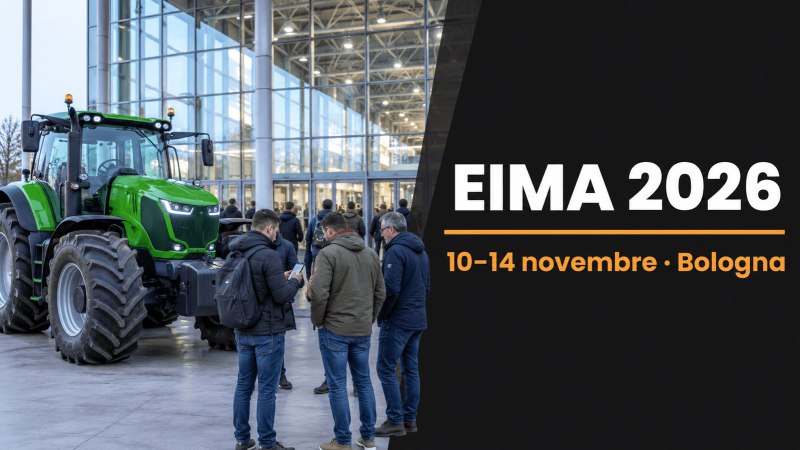
- EIMA 2026 closed in Bologna with over 370,000 visitors, up 7% on 2024, and about 1,800 exhibiting companies, 700 of them foreign.
- Italy has introduced technical inspection for fast wheeled tractors, meaning those with a design speed above 40 km/h in categories T1b, T2b, T3b, T4b and T5.
- The Italian guidelines focus on three areas: braking system, electrical system and exhaust emissions.
- The checklist below is general good practice, not an official inspection list.
A full fair, a quiet reminder
EIMA closed on 14 November with over 370,000 visitors and about 1,800 companies, 700 of them from abroad. For many visitors the show was about new machines. For anyone who already owns a fast tractor, it is also a good moment to ask a plainer question: is the one in the yard ready for the road checks that are becoming normal for this class of machine?
What fast tractors are, and why inspections are arriving
In Italian rules a fast tractor is a wheeled tractor with a design speed above 40 km/h, used mainly on public roads. Italy has put a periodic technical inspection in place for this class, with operations starting in 2026, under rules that transpose EU Directive 2014/45 on roadworthiness tests. If you operate elsewhere, your national rules apply, but the logic is the same: faster machines on public roads are held to road-vehicle expectations.
A practical pre-inspection checklist
| Area | What to look at | Why it matters |
|---|---|---|
| Brakes | Efficiency, wear, leaks in the circuit | A core section of the Italian inspection guidelines |
| Electrical system and lights | Bulbs, wiring, working lamps not dazzling, plate and reflectors | Missing or misaligned lights are a simple reason to fail |
| Emissions and engine | Filters, abnormal smoke, oil and fluid leaks | Emissions are the third core area of the guidelines |
| Tyres, steering and axle | Wear, pressure, play in joints | Looseness grows quickly at road speed |
| Paperwork | Registration papers, service records, booking confirmation | Keeping everything in one folder avoids delays |
- Check your papers
Find the registration document and confirm the machine's category and design speed.
- Book early
Inspection capacity is limited near any deadline, so contact the inspection centre as soon as you know the rules that apply.
- Service before the test
Replace worn consumables and fix leaks so the machine arrives in documentable condition.
- Keep the record
File the invoices and the inspection result with the machine's papers.
Get the parts before the test
Filters, lubricants, lighting and workshop spares: browse the Agrokron catalogue. Fast and tracked deliveries throughout Europe.
What counts as a fast tractor?
In the Italian rules, a wheeled tractor with a design speed above 40 km/h in categories T1b, T2b, T3b, T4b or T5, used mainly on public roads.
Is this checklist the official inspection list?
No. It is general good practice. The official requirements are set by your national authority and the inspection centre.
Why prepare before booking the test?
A simple defect such as a failed light or a small leak can mean a second booking. Preparing first saves time and a repeat trip.
Sources