 Tractor Spare Parts
 Farm Implements
 Lubricants & Additives
 Gardening & Outdoor
 Workshop & Industry
 Forestry & Wood
In this article
At a glance
- EIMA 2026 (10-14 November) closed with 370,000 attendances, 7% more than in 2024, including about 68,000 from abroad.
- Projections for 2026 point to a 5.4% drop in Italy's agricultural machinery market.
- Sales of used tractors have grown far more than new ones, and the average age of the fleet exceeds 25 years.
- The next EIMA is scheduled for 14 to 18 November 2028.
A record that is not enough to move the market
Bologna hosted 1,800 exhibiting manufacturers, 690 of them foreign, and attendance beat the previous record. Yet FederUnacoma itself acknowledges that this year's sales are down worldwide. The cause it points to is not a lack of interest but factors outside the sector: lower yields and farm incomes, and higher costs for energy, raw materials and transport.
Those who walked the halls describe a more cautious mood. The Italian trade magazine L'Informatore Agrario reports manufacturers raising list prices to cover higher production costs and dealers holding more machines in stock. According to Agrievolution, the international body of agricultural machinery manufacturers, 2026 is closing lower in the main markets, from the United States to Brazil to Italy, with India and China as the only exceptions.
The numbers that matter if you already own a tractor
The most discussed figure comes from the Agrofarma-Federchimica Observatory, produced with the research firm Areté and with input from FederUnacoma, as reported by TCE Magazine. It says that those who do not buy new are not standing still: they buy used, and keep what they have for longer. The figures refer to Italy.
| Indicator | Value |
|---|---|
| Used tractor sales (2014-2025) | +144% |
| New tractor sales (2014-2025) | -3% |
| Average age of the fleet in use | over 25 years |
| Used tractors sold in 2024 that were over 15 years old | 70% |
| Projection for the agricultural machinery market in 2026 | -5.4% |
“The figure is worrying because buying used machines slows the innovation process” – Mariateresa Maschio, president of FederUnacoma
Maschio links the problem to economic constraints, but also to the difficulty many farmers have in using new-generation machines and to a shortage of specialised technicians. It is a picture that innovation policies will have to address, but in the meantime the tractors in the field are the ones already there.
The Agrokron point of view
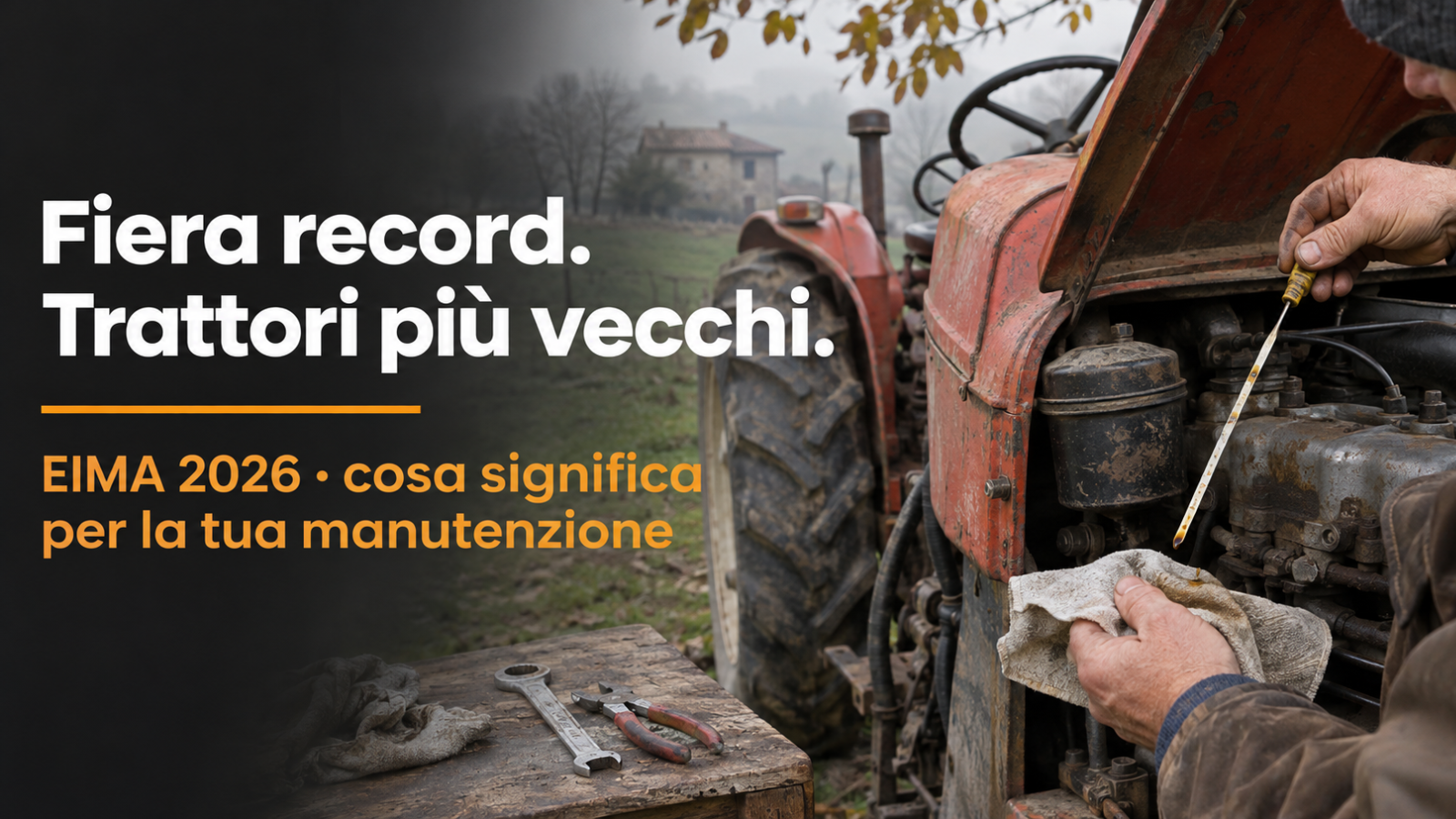
This is our own reading, not a statistic: when a machine has to stay in service for years to come, scheduled maintenance stops being a cost to postpone and becomes the most concrete way to protect the investment already made. On a high-hour machine, a filter changed on time or a lubricant with the right specification costs little compared with downtime in the middle of the working season.
This matters most for those who run several machines and serve several customers: every hour of downtime weighs on the whole calendar. That is why it makes sense to think in terms of prevention and keep wear parts under control.
Five checks to keep a high-hour machine going
You do not need a fully equipped workshop for the basic checks. This is the quick round to make with the machine stopped.
- Check levels and leaks
Engine oil, hydraulic oil and coolant: look at the levels when the machine is cold and check for signs of seepage under it.
- Change filters on schedule
Oil, fuel and air filters follow the intervals in the manual. On older, high-hour machines it is not worth stretching them.
- Use the right lubricant
Follow the manufacturer's specifications for engine, hydraulics and transmission, not just the viscosity grade.
- Grease the pivot points
Pins, universal joints and accessible bearings: wear often starts here.
- Inspect belts, hoses and seals
Look for cracks, hardening and leaks. These are wear parts best replaced before they fail at the worst moment.
Have a tractor to keep in shape?
The Agrokron catalogue offers spare parts, lubricants and tools for the maintenance of tractors and agricultural machinery. Fast and tracked deliveries throughout Europe.
How many visitors did EIMA 2026 have?
Attendance was 370,000, 7% more than the 2024 edition. About 68,000 came from abroad, from 150 countries, up 7.9%.
When is the next EIMA?
FederUnacoma has announced the next edition of EIMA International in Bologna from 14 to 18 November 2028.
How old is the tractor fleet in Italy?
According to data from the Agrofarma-Federchimica Observatory reported by TCE Magazine, the average age of the fleet in use exceeds 25 years, and in 2024, 70% of used tractors sold were over 15 years old.
Sources
- TCE Magazine – EIMA 2026, il bilancio della 47ª edizione
- L'Informatore Agrario – I record di Eima International e le voci tra i padiglioni
- Farmers Guide – EIMA 2026 attracts record 370k visitors
- ANSA – Eima chiude con oltre 370mila visitatori, +7% rispetto al 2024
- Terra e Vita – Eima 2026, record di presenze con 370 mila visitatori